


Get ready to say goodbye to the private conversations users once had with ChatGPT.
From now on, every prompt may be used as a commercialised pathway, with responses accompanied by ‘unbiased’ recommendations from the chatbot.
OpenAI has confirmed it will begin testing advertising with free ChatGPT users in the coming weeks, following months of leaks and speculation.
While the ads have not yet rolled out, the move signals a fundamental shift in how the platform will operate for its vast non-paying audience.
How will it function?
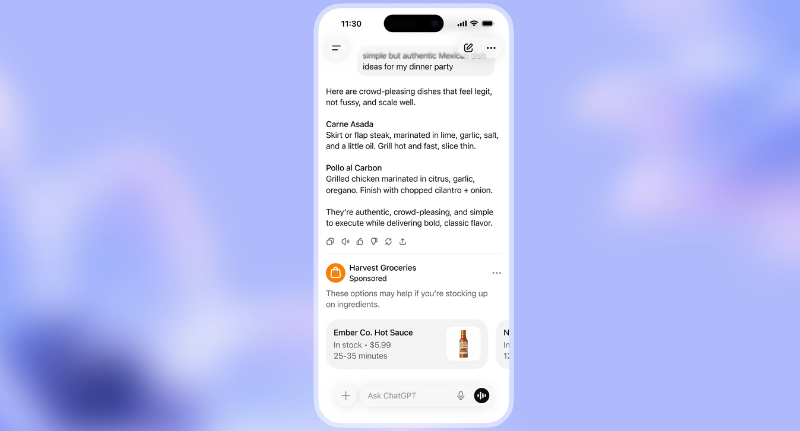
ChatGPT Ads.
Ads will appear at the bottom of responses when a sponsored product or service is relevant to the conversation, and will be clearly labelled and separated from the chatbot’s answers.
“Most importantly: ads will not influence the answers ChatGPT gives you,” said Fidji Simo, OpenAI’s CEO of applications, in a social media post.
The move is part of OpenAI’s broader push to generate revenue from ChatGPT’s more than 800 million users, the vast majority of whom access the service for free.
A money recovering move
Despite a reported valuation of around US$500 billion, OpenAI continues to lose money and faces enormous costs tied to AI infrastructure, including chips and data centres.
OpenAI said advertising will support its original mission, noting the company’s transition last year from a nonprofit to a public benefit corporation. It added that ads would not be driven by personal user data or prompts.
Still, critics warn that the strategy carries risks. Miranda Bogen, director of the Centre for Democracy and Technology’s AI Governance Lab, said introducing ads could undermine trust in tools people increasingly use as advisors and companions.
“There’s a lot at stake when that tool tries to exploit users’ trust to hawk advertisers’ goods,” she said.
The shift also places OpenAI more squarely into competition with Google and Meta, both of which already integrate advertising into AI-powered products.
OpenAI CEO Sam Altman defended the approach, saying many users want AI services without paying, and advertising could be a viable solution. He also noted he personally finds some Instagram ads useful.
Analysts remain cautious. Forrester’s Paddy Harrington said claims around limited data use may evolve over time as commercial pressure grows.
“Free services are never actually free,” he said. “If the service is free, you’re the product.
Top Image: Sam Altman