

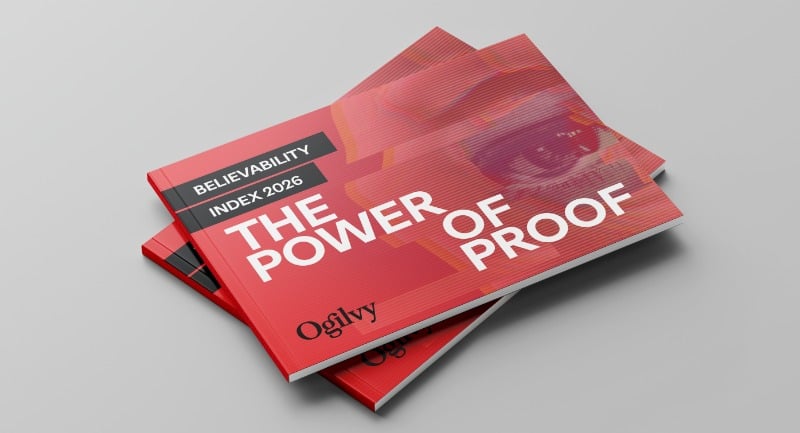
Ogilvy Australia’s latest Believability Index 2026: The Power of Proof has found 92 per cent of Australian consumers will silently disengage when brand believability is lost.
The research suggests the biggest reputational risk for brands may not be public backlash, but customers quietly leaving without warning.
READ MORE: Back Australia campaign lifts support for Australian-made products: YouGov
READ MORE: Ogilvy wins Movember PR account in competitive pitch
According to the report, consumers who stop believing a brand are most likely to stop purchasing, quietly switch to a competitor, or avoid the organisation’s content without telling anyone.
What did Ogilvy’s Believability Index find?
The report found 58 per cent of Australians stop buying from a brand when believability is lost, while 37 per cent quietly switch to a competitor.
A further 22 per cent simply avoid the brand’s content. Only six per cent said they would post a negative comment about a brand experience on social media.
Richard Brett, President Ogilvy PR & Influence Asia and ANZ, and Chief Client Officer ANZ, said believability is now a critical indicator of business health.
“For years, the communications industry has equated reputational risk with visible, public outrage. But our data proves that managing the vocal minority means missing the silent majority. By the time a consumer publicly complains on a forum, multiple others have already transferred their loyalty to a competitor without leaving a digital trace. The true cost of this ‘silent exit’ is measured in lost revenue, not negative headlines.”
Australians want proof they can verify
For the first time, Ogilvy’s index examined how consumers across seven Asia-Pacific markets decide what, and who, they believe in a more complex information environment.
The report found Australians place greater weight on lived experience than institutional authority. More than half of Australians value lived experience as the most credible source, rising to 60 per cent among Baby Boomers.
By comparison, 57 per cent of consumers in Singapore find government or official sources the most believable on important issues, compared with 30 per cent of Australians.
Australia also emerged as the region’s most evidence-demanding market. When making high-stakes decisions, 59 per cent of Australians prioritise evidence they can verify themselves among their top three sources, compared with the regional average of 48 per cent.
“Australians have long prided themselves on a healthy scepticism of authority and that scepticism has deepened in 2026. A single APAC communications strategy is almost certainly bound to underperform here,” Brett said.
Competence outweighs purpose
The report found product and service performance remains a major driver of brand belief in Australia.
Thirty-eight per cent of Australians said they abandoned an organisation in the past year because a product or service did not do what it promised. That was higher than the 24 per cent who left over poor business ethics.
Ogilvy also found factual correctness is Australia’s top believability attribute, cited by 71 per cent of respondents. It was followed by integrity at 65 per cent, relevance at 49 per cent, commitment at 45 per cent, shared values at 36 per cent, and affinity at 27 per cent.
Belief can be rebuilt
The index found lost belief is not always permanent, with 83 per cent of Australians saying it can be regained.
That view differs by generation. Ninety-three per cent of Gen Z respondents said belief can be restored, compared with 73 per cent of Baby Boomers.
However, the report found consumers expect more than a traditional apology. Fifty-eight per cent said they want active operational correction before believing a brand again, ahead of the 50 per cent who prioritise public acknowledgement.
Ogilvy launches diagnostic tool
Ogilvy PR has also launched its Believability Diagnostic Tool, powered by WPP Open.
The tool uses Ogilvy’s seven-year Believability dataset and a behavioural science engine to analyse the gap between a brand’s marketing promises and operational reality.
According to Ogilvy, the tool is designed to help organisations identify where disbelief is forming before it becomes customer churn, reputational damage, or lost revenue.
The Ogilvy APAC 2026 Believability Index: The Power of Proof was conducted with YouGov. The study surveyed 7,176 adults across Australia, Hong Kong SAR, Indonesia, Malaysia, Mainland China, Singapore and the Philippines.
Fieldwork was conducted online from 22 April to 4 May 2026, with data weighted to represent national or online adult populations aged 18 and over in each market.