



7.30’s Sarah Ferguson on her extraordinary Gisèle Pelicot interview
EXCLUSIVE: 'The tooth story is in the book - but I chose not to ask her about it.'

If you haven't heard of Gisèle Pelicot, the ABC's TikTok clip about her begins: "What it's like to interview a survivor of the most 'depraved' crimes."
So, you know the video will most likely be distressing content - and it is - but not as much as it could have been.
The way veteran Australian journalist Sarah Ferguson interviews Pelicot - who was sexually abused in the most shocking ways for nine years by her husband Dominique Pelicot, and strangers from the internet - is a masterclass in empathy and sensitivity, whilst allowing the subject to tell their story, their way.
Ms Pelicot is not further traumatised, and the viewer, is in fact, inspired.
It seems impossible; Mediaweek asked the ABC's Ferguson how she achieved that.
Interview background: the depraved abuse of Gisèle Pelicot
Dominique Pelicot's violent abuse of his wife began in 2011, but Gisèle Pelicot, who was in her 60s at the time, did not learn of it until 2020, after he was caught secretly filming up women’s skirts at a supermarket.
When the police arrested him, they discovered videos and photographs of his wife being brutally sexually assaulted by at least 70 random men, whilst she was heavily sedated - which he had recorded and posted online.


The leading media trade publication in Australia.
Get our top stories straight to your inbox daily by signing up to our Newsletter
By providing your information, you agree to our Terms of Use and our Privacy Policy. We use vendors that may also process your information to help provide our services.
Prior to the trial in 2024, Pelicot waved her right to anonymity as the victim in a multiple rape case, and in doing so, became a hero to women around the world. Thousands contacted her in support - and to share their own stories of abuse.
"The shame is theirs", she said at the time of the trial of the men accused of raping her.
"I'm lucky to have the evidence. I have the proof, which is very rare. So, I have to go through this to stand for all the victims."
On 19 December 2024, Dominique was convicted of aggravated rape and given the maximum 21 year sentence.
This year, Pelicot published a memoir, A Hymn to Life: Shame Has to Change Sides, in 22 languages - for every survivor of abuse.
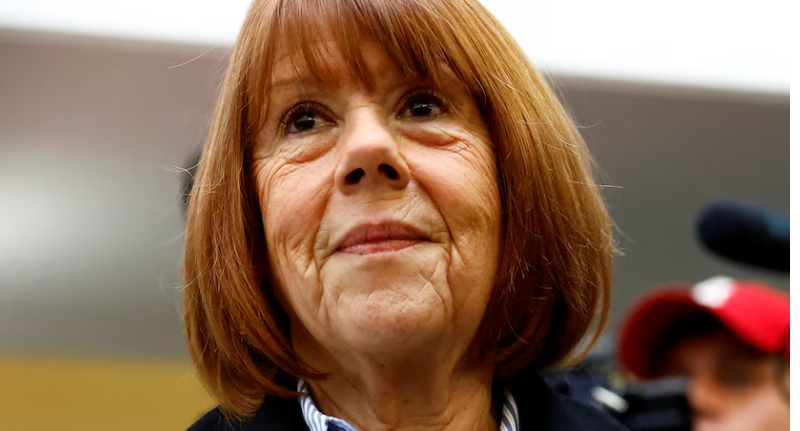 Gisele Pelicot outside court. Image: ABC
Sarah Ferguson shares how she prepared for Gisèle Pelicot
Ferguson admits that preparing for the interview with Pelicot was a unique experience because of the nature of the crimes against her but also, her renown dignity.
"I knew she would be composed. She's already re-lived her story at trial, and in her book, and has done some interviews.
"She's a woman of great dignity, and it was my job to let her tell her story her way."
An example of Ferguson doing that job was her decision not to include one of the more heinous moments of Pelicot's abuse experience - the horrific 'tooth story', where a crown had become inexplicably dislodged in her mouth overnight, and Dominique claimed ignorance.
The story was recalled in court, and has been described in the book, but Ferguson declined to ask Pelicot about it.
Of that decision, the journalist said: "The New York Times included it in their interview. And it's in the book. So people can know about it if they want. But I thought in a recorded interview, it would be too much for the viewer to absorb in the context of everything else."
Ferguson further explained that it's standout moment of depravity that "so-called normal people" would have trouble digesting.
She's right; it's one that will haunt you if you ever read about it.
To truly understand the gravity of Ferguson's decision, this is what was printed by the NYT: "There’s one moment you describe in the book when a crown came loose in your mouth. You write that it was because of 'the violence of penises being repeatedly forced into my slack mouth.' When that crown started to move, I was eating breakfast, and Monsieur Pelicot was in front of me. Because of Covid, we can’t see the dentist. And I can’t get it out.
"But I know it’s going to fall off, and I’m afraid I might swallow it. And I ask Monsieur Pelicot, 'Could you help?' He went to get some gauze to remove the crown, and I thought to myself, How could it have given way? The day before, it wasn’t loose. And he says to me, 'You must have bitten down on something."
Indeed, she had.
"When I discovered the videos showing the violence these men inflicted on me, in my limp mouth - they have to hold my head because my face is falling, I have no muscle tone - and Monsieur Pelicot doesn’t even react. There is no empathy, no pity for this woman who is there, completely dead in her bed."
What Ferguson asked in her Pelicot interview
Instead, Ferguson chose to focus on the parts of the story that are important to the most incredible of survivors - because that's what Pelicot wanted.
"Her story stands out to me because she wanted to be known by her name," Ferguson says. "She did that because she wasn't ashamed. What happened to her was not her fault. She has written the book for other survivors."
She adds, "I don't want to rate my interviews, but speaking to Gisèle was extraordinary, not only because of the nature of the details, but also her dignity and impact."
@abcnewsaus 7.30’s Sarah Ferguson explains what it was like interviewing Gisèle Pelicot, the survivor of a series of crimes that shocked the world. Sexual assault support lines: • 1800 Respect National Helpline: 1800 737 732 • National Sexual Abuse and Redress Support Service: 1800 211 028 • Bravehearts, counselling and support for survivors of child sexual abuse: 1800 272 831 • Men's Referral Service: 1300 766 491 • Lifeline (24-hour crisis line): 131 114 • Victims of Crime Helpline: 1800 819 817 #ABC730#GiselePelicot ♬ original sound - ABC News Australia
Ferguson greets Pelicot in French
At the start of the interview, Ferguson greets Pelicot in French. Her accent is very impressive - does she actually speak French?
"Yes, I do," Ferguson laughs.
"But I didn't feel it was right to do that entire interview in French, even though Gisèle answered in French. I thought of the audience.
"Gisèle actually had an interpreter to repeat my questions, but that could be challenging, and I had to sometimes say, 'Wait, that's not what I meant.'
"There's usually a preamble to a question, and the interpreter could pose the question differently. That's more than just language. And it's one of the issues of doing remote interviews, especially when the sensitivity needed is at that level.
"We did have a nice chat in French afterwards. She's a very warm person."
As to whether the interview would have been different in person, Ferguson says, "We really tried to make that happen, because interviews are always stronger in person. You can convey a different understanding and respect to make someone comfortable."
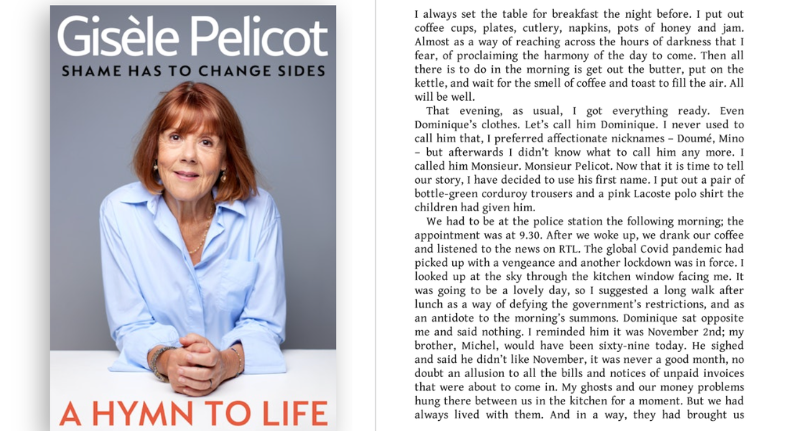 Gisèle Pelicot's memoir. Image: Penguin
Excerpt from Sarah Ferguson's interview with Gisèle Pelicot
SF: You had to learn the terrible details of how Mr Pelicot was able to do the things that he did by rendering you unconscious. How was he able to do that? How did he do that?
GP: He explained to the court that he had subdued a defiant woman because when we were together, our relationship was pretty good.
I wasn't under Mr Pélicot's control; on the contrary, I stood up to him when we disagreed. We sometimes had difficult moments, but he knew I wasn't under his control, and it would have been very complicated for him to get the sexual favours he wanted from me.
So, since he had this perversion in him, he found a nurse on the internet who explained to him what the protocol was, and that's what he did.
Over the years, he would increase or decrease the doses so as not to put me in danger, that's what he said. But of course, my life was in danger. I might not have been here, in front of you, today.
This perversion, perversion, he had it in him for years, but he didn't have it. I think he had buried it deep within himself for a very long time. But with the childhood he might have had, I think all of that came back to the surface.
SF: You said at the trial, I don't know how I'm going to reconstruct, rebuild myself, but it seems to me you are rebuilding yourself. In the book, at the heart of the story, there is a search for love after the devastating loss of one's mother as a child. She resonates through the book. If she were here now, what would you tell her about how you are doing?
GP: I would say ‘thank you’ to her, not just to my mother, but also to my father. They gave me good genes to cope with life's difficulties. They also dealt with sickness, pain and grief and stayed standing.
They passed on a joy in living to me, and I am passing the same torch of this joy to all the women and men listening to me today.
Life is worth living, and you absolutely must be happy. Allow yourself happiness, because we live in a very anxiety-inducing world, and we need messages of love and peace. It is very important to be at peace with oneself. You have to deeply reinvent your life, even after 70, it’s very important.
To love again is a beautiful victory for me, to have the chance to love again, that it’s possible for me to trust someone, to trust a man again.
You can watch the full interview here.
Sexual assault support lines:
• 1800 Respect National Helpline: 1800 737 732
• National Sexual Abuse and Redress Support Service: 1800 211 028
• Bravehearts, counselling and support for survivors of child sexual abuse: 1800 272 831
• Men's Referral Service: 1300 766 491
• Lifeline (24-hour crisis line): 131 114
• Victims of Crime Helpline: 1800 819 817
Top image: Sarah Ferguson, Giselle Pelicot. Image: ABC
More from Mediaweek
The leading media trade publication in Australia.
Get our top stories straight to your inbox daily by signing up to our Newsletter
By providing your information, you agree to our Terms of Use and our Privacy Policy. We use vendors that may also process your information to help provide our services.


